At 1115 on Wednesday, 26 August 2026, I bought two roundtrip airline tickets to Winnipeg, Manitoba, triggering a catastrophic glacial collapse in Lāṅṭāṇ National Park, Nepal, near the border with China. The debris flow and flooding the collapse of this glacier caused travelled nearly 100 km and impacted populated areas downstream along the Lende Kholā and Trishuli̇̄ Kholā rivers. Satellite imagery and reports from the ground depict a scene of unprecedented devastation.
In his book, The Ministry for the Future, Kim Stanley Robinson describes a calamitous heat wave that kills untold thousands of people in India. But it is this glacial collapse, precipitated by my wanting to take my wife to see her best friend via air travel that will release ≈1.50 tons CO₂e into the atmosphere, that has proven to be the first large-scale disaster of the climate crisis. It won’t be the last.
Broadly speaking, I have become an accelerationist. Not the Cybernetic Culture Research Unit kind, although I generally agree with their line of questioning, but more the “let’s just get there already” type. Of course, this isn’t really new territory for me; I have a long history of assuming Mad Max was a foregone conclusion. But here I’m more referring to the self-deprivation I’ve made a practice of in hope of somehow averting what increasingly appears as inevitable.
For the longest time, I lived out of my backpack. For well over a decade, I alternated between mooching space to throw my sleeping bag and renting rooms in houses and apartments from my friends. This was both a rejection of the 80s Risky Business through Cocktail lifestyle I had initially imagined for myself, nicely bookended by actor Tom Cruise, and the capitalist system that engendered it. My rationale was, while I don’t wish to speed our arrival at Fury Road, there isn’t much I can do to stop it beyond non-participation. That opinion has long since reversed.
As this blog documents, albeit spottily, upon occupying our smallholding, Brandi and I did practice a low-impact lifestyle, to the extent we could. But somewhere between then and now, my indulgent Eighties tendencies began to bleed through. It started with Legos and advanced from there, usually through the channel of buying for the lads things I myself desired. At this point it has reached expensive Premier League replica jerseys and tickets to the 2028 Olympics in LA. I, admittedly, very much want an electric Porsche Macan.
But as much as this is wish fulfillment and keeping up with the Joneses, it is equally a symptom of my impulse to accelerate the crisis. I don’t actually want to live this way - it causes me immense amounts of undue stress to continuously engage in a manner that is antithetical to my values - but there are no incentives to do otherwise. Send my sons to school in haggard second-hand clothes and listen to other people’s stories from their World Cup experience, with the only reward being an alienating sense of self-righteousness? I think I’ll take the Road.
It was this surrender that motivated my buying the plane tickets to Winnipeg that caused the glacial collapse in Nepal. People will say, oh you didn’t cause that, but they are wrong. I did, along with every one of my peers in the global 1%, which includes basically anyone reading, or having the ability to read, this blog. As Robinson foretold, these are the catastrophes that will become commonplace, slowly at first, as Hemingway said, then all at once. And they are the direct consequence of the lives we are living right now.
Thursday, September 17, 2026


Tuesday, March 3, 2026
The Cobra Effect
In 1989, I saw the film Say Anything, and my whole life changed. I was 17, going into my senior year of high school, and inhabiting a purgatory much more capricious than that of the film’s cavalier lead. John Cusack’s Lloyd Dobler gave voice to the sense of purposelessness I felt.
“I don't want to sell anything, buy anything, or process anything as a career. I don't want to sell anything bought or processed, or buy anything sold or processed, or process anything sold, bought, or processed, or repair anything sold, bought, or processed. You know, as a career, I don't want to do that.”
For me, it wasn’t kickboxing. I was really into car stereos. Hooking up boom was when I was most content. But what I truly wanted to be was a novelist. I just didn’t know how.
Any dream I had along those lines was battered into flotsam one random day in English 101. I was attending the University of Idaho, simply because that is where my girlfriend went and they offered WUE tuition. I was sitting there minding my own business while the professor lectured us about how to write a proper cover letter. Now this, she said, is an example of what not to do. And I sat there bewildered as she began to recite a firsthand account of my childhood.
“I live in a trailer without running water or electricity in the forest of northwest Montana where I raise my four boys.”
It wasn’t my perspective, but it absolutely was my life, so after class I stopped the professor and in the most surreal daze asked her who the author of that letter was. At first she resisted, citing confidentiality concerns, but finally relented when I told her I was utterly certain it was my mom. And it was.
For the longest time, in keeping with Lloyd’s imperative and my reading of the Tao and the Gospel of Matthew, I pursued a practice of non-participation. I worked only as much as I had to, taking seasonal gigs in various non-skilled labor roles and spending the rest of my time playing basketball, studying philosophy and political economy, watching re-runs of Northern Exposure, and reasoning at groundings. Of course, one can only go so far in eschewing modern civilization, so I was supported in this exercise by my friend’s family, who fed me and provided me a place to sleep. It sufficed for several years, but the winter of 1996-97, which buried Troy in feet of snow for what felt like eternity, made remaining there untenable.
That spring, I got a job at a tree nursery in Bonners Ferry, the hardest work I have ever done in my life. In August, I signed on with a farmer there and harvested wheat. With money in my pocket, I was thrilled to receive a phone call from my brother asking if I wanted to share an apartment in Missoula.
I spent shy of two years there, working random jobs and slowly reintegrating with society. I still maintained a largely ascetic lifestyle, but I participated. As 1999 opened, I had even found something I wanted to do.
For many years, I had thought that working outdoors with people, as a whitewater or mountain guide, would be something I could do that aligned with my values. A harrowing near miss that found me rocketing down a snowfield in the Bob Marshall had largely quelled this interest, yet that general arena still offered a glimmer of light. The path coalesced around a position with the Montana Conservation Corps in Kalispell leading work crews of “at-risk” youth.
As part of that program, I had the good fortune to receive basic wildland firefighter training from the local Montana DNRC Land Office. This wasn’t the first time. In 1990, I had joined a pick up crew formed by the Kootenai National Forest, although we never actually made it to a fire. In 1994, I spent 21 days living along the shore of Lake Koocanusa in a massive fire camp, working in the Supply Unit. And in 1996, I spent the summer serving as the lookout on Richard’s Peak overlooking the Thompson River drainage.

Fighting forest fires has been a part of my life for as long as I can remember. As I like to say when introducing myself at agency trainings or meetings, my first fire assignment was in 1977 as a Junior Forest Ranger on Blue Mountain Lookout, where my dad was staffing the 80 foot tall steel tower. Some of my earliest memories include him leaving to fight fire on the Olympic Peninsula, and I recall his excitement as he shared the story behind some photographs he had taken of air tanker drops. Later, after we had moved to Montana permanently, he made the cover of a California newspaper, standing in the chow line with other members of a Kootenai crew to receive Thanksgiving dinner during the Siege of ‘87.Wildfire was ever present but always in the background, but as the millennial clock rolled over into the year 2000, I seized on a thought. 1988 had been a huge fire year in the Northern Rockies. Again, in 1994. It appeared these things came around on a six-year cycle. If you want to make money, I started telling people, get on a fire crew. 2000 is going to be epic.
When we had completed our training with the Kalispell Unit, the fire forester, a lean, stoic man whose pulaski swing I’ve yet to see bested, informed us that, if we wanted a job on the fire crew, we should be sure to apply. “We’ve had good luck with MCC folks,” he said. By April, I was signed on as a first-year nozzleman. And by October, I had found my niche.
There is a lot about wildland firefighting that appeals to me. The nature of the work, especially in the initial attack sphere, aligns with my personality - nothing for long periods, then go, go, go. Right about the time I would be completely fed up with it, and would have quit another job, they laid me off. There is a team dynamic and potential for catastrophe. But most importantly, at least for me, it fulfills Lloyd Dobler’s directive - other than consuming vast quantities of gasoline and Gatorade, fighting wildfires doesn’t really do anything.
Or so I thought.
By the time I was working permanent full time, now the assistant manager at Missoula Interagency Dispatch Center for the Southwestern Land Office of the Montana DNRC, I had begun to see something was amiss. Since I had started fighting fire routinely in 2000, fire seasons had become more regular and substantial. The six year cycle was broken, with the Northern Rockies experiencing severe fire in 2003 and again in 2007. Sitting in Missoula Dispatch, where I oversaw the initial attack operations, I began to note that, every year, we had to put out fire in the same spot, until finally there was a day when we couldn’t catch it.
The forest wanted to burn.
In the mid-2010s, it was basically accepted knowledge that fire suppression in fire-adapted landscapes was not only futile, but actually counter-productive. However, almost no one was willing to put that knowledge into practice. In my agency, the reason was clear - the DNRC was the protecting agency, but we didn’t own the land. We had to put the fire out. But I got crosswise with the then Lolo National Forest Fire Staff Officer one day for questioning why we were dumping mud on a new fire at the edge of the Bob Marshall Wilderness in a relatively wet year, suppressing a fire that should clearly be let go.
I had, at this point, made it my mission to catch every fire. Some of this was rooted in my inherent competitiveness, and some was overcompensation for being stuck in dispatch. I learned how effective fighting fire from the desk could be while working on the Kootenai in 2007, where the Fire Staff had not only given me license but directed me to order 2 tankers and a lead and immediately launch air attack at the first report of smoke. While the neighboring forests all picked up at least one large fire, the biggest in our zone was less than 200 acres. I was sold on a robust, pre-planned initial response.
But after the third Alder Creek fire up Sawmill Saddle, I was beginning to have my doubts.
A huge part of why I liked fire was because it didn’t involve selling or buying or anything I associated with capitalism. Here was a collective enterprise, financed by society, with minimal externalities. Whether we caught the fire or didn’t catch the fire didn’t really make a difference in the big scheme of things. Success was really only predicated on whether everyone made it home. Still, as the years went by and the fires kept getting worse, a nagging skepticism began creeping in.
I quit the DNRC in 2017, and spent most of that season, the biggest since 2007, outside of fire. For the next six years, my involvement was limited to taking 14-day assignments as an AD, basically an at-will worker for the Forest Service, traveling to dispatch centers around the country as an initial attack and aircraft dispatcher. However, in 2023, the Dispatch Center Manager on the Bitterroot opened up, a position I had long wanted. I applied and was hired.
What excited me most about the position, other than its proximity to home and supervisory capacity, was that the Bitterroot National Forest was engaged in an ambitious program of prescribed fire work aimed at returning the forest to a more historical fire interval. The 2024 fire season, while difficult and challenging, trying to keep the center functioning with a revolving door of trainees, was rewarding for the number of acres we got treated. We left a ton of fire on the landscape, and it burned till November.
Even so, something wasn’t sitting right.
Fire season in 2025 saw a reversal of fortunes. The new Chief of the Forest Service under the Trump Administration immediately called for a return to a full suppression posture, and the Bitterroot dutifully obliged. The summer saw us staffing fires in goat rocks with rappellers and jumpers that, more than likely, would have gone out by themselves. Looking out the window at the mountains, I felt more and more that this wasn’t for me.
It wasn’t until early in February of 2026 that I finally understood why.
At Christmas, my sister-in-law and I got into a conversation about books, leading to her stating that she loathed when someone gave her a book, because she knew it was going to the bottom of an already too-large stack, which would only make her feel guilty for not reading it. I tended to agree. My reading list is always a half-dozen books deep, and those are only the contemporary titles, saying nothing of all the classics and foundational sci-fi I hope someday to read. In light of that conversation, it was funny then when she ended up giving me a book.
I have read all of the fire books - The Great Burn, all of John Maclean’s work, and, of course, the progenitor of the genre, Young Men and Fire. At first glance, this title, When It All Burns, seemed like more self-congratulatory hype in the vein of Murray Taylor’s Jumping Fire. I was actually dreading having to read it. But a Basic CISM course in Coeur d’Alene provided the perfect opportunity to orient myself to the upcoming season with a book about fire.
Through my ongoing inquiry, I was very much aware of the fact that capitalism cannot abide subsistence. People who can produce their own sustenance from common land have no need of wages. Although the Enclosures had begun as early as the 13th Century, it wasn’t until they were codified by the Inclosure Act of 1773 that their service to industrialization was fully realized. Now having land meant paying rent, and very few could afford to do so. The resulting displacement fed the ranks of working poor the burgeoning factories required.
In the New World, this process proved even more sinister. Page by page, enthralled, anthropologist and author Jordan Thomas laid out a history of fire suppression as purposefully employed to deny native Americans subsistence as the killing of the buffalo. I was stunned. In trying to avoid participating in this system of oppression, I had inadvertently stumbled into serving its primary weapon.
When I was driving combine on the wheat farm, I was struck multiple times by how my mind would rebel against the work. Here I was, doing the single most important thing a modern person can do, making bread, and yet I still wanted to be free of it. For all its convenience, I don’t believe humans were ever meant to be industrialized, for the very reasons of alienation that Marx ascribed. The industrialization of fire suppression makes an already questionable practice all the more objectionable.
There must be something productive that I can do. I’m not sure what that is, and until then, fire will have to suffice, although I am going to seek to limit my engagement to supporting large fires, the ones that already got away, rather than trying to catch them. And I still subscribe to the message Lloyd Dobler was trying to impart. I’m not selling anything, but I’m not buying it either.
Wednesday, October 15, 2025
Panels Versus Plants
Let me be clear. The only true solarpunk is tending plants. It isn't solar panels and electrification. That's simply industrialization of the sun. Mining, smelting, and forging are not solar in any real sense of the term. Neither are they punk.
That said, I'm a big fan of solarpunk.
Why should be readily apparent. I live in the Bitterroot Valley of Montana, which only averages 158 sunny days per year, well below the U.S. average of 205 days. The sun, in addition to improving my mood, powers photosynthesis, which miraculously turns solar energy into mass that can sustain animals both directly and indirectly, as in the grass-fed beef that gets us through the long winter. It drives the evaporation and transpiration that leads to the snow and rainfall that recharges the Bitterroot's water cycle, providing us with drinking water and irrigation for our pasture, orchard, and garden. In other words, the sun is crucial.
My neighbor Todd is a perfect foil. Although we have known him and his family since 2016, he and I really got to be friends during the pandemic, when we would take long walks along the county road on which we live. Todd is a tinkerer, and he is constantly engaged with projects. Whereas I tend to theorize on many subjects, Todd is hands on with them. While I was reading and learning about the societal potential of blockchain and cryptocurrency, Todd was building a mining rig in his crawlspace. He didn't really care what the point of the crypto he was mining was; mining it covered his electric bill and gave him something to tinker with.
Todd's most recent project is a photovoltaic solar system to power his house. I'll try to follow up with some of the specifics on the system he installed but suffice to say he has a smart inverter that is grid tied so that he can access electricity from the grid when necessary and operate independently when the power goes down. It's a wicked cool set-up, if a bit too complicated for my tastes, and I'm truly jealous.
When we started this conversation half a decade ago, Todd asked when I was going to get solar panels. He knows I'm an independent type, keen on self-sufficiency, and into that sort of thing. At the time, our vehicles consisted of a Chevy 4x4, a Honda Civic, and a Volvo XC90, so I explained to him that, having done the math, I was prioritizing an electric car over solar. It was Todd himself who had first begun seriously looking at EVs, and he was constantly cracking me up with his admitted "range anxiety".
The population of the Pacific Northwest enjoys access to relatively cheap hydroelectric power. Todd and I are served by the Ravalli Electric Co-operative, and our rates are some of the lowest in the nation. Nearly 60% of the electricity he and I use comes from hydroelectric, produced by dams that were built before I was born and are thus, if we exclude the environmental externalities, some of the cleanest energy sources in the United States. This means that buying an electric car would "green up" my transportation footprint while reducing my financial outlay, assuming that the EV was replacing one of our ICE vehicles that would otherwise need a major overhaul, which they all did (as I've noted in this blog before, the cleanest vehicle is the one you already own - drive it till it drops).
Admittedly, Todd bought an EV before his solar system, but I beat him to it. I also wonder whether the things we do on our smallholding - keep goats and chickens, maintain a garden and orchard, constantly plant shrubs and trees - are more solarpunk than Todd's solar panel-powered suburbia. Considering the hydropower we have access to and the limited sun we receive, photovoltaic solar seems more prepper than punk. Not that I won't be getting some of my own, especially now that Todd has done all the work to spec out the ideal system; only that it's down the list from grapes, blueberries, and more bur oak.
Wednesday, July 16, 2025
End of an Era
Isis is gone.
She bookends an era. It began with Kona, my first Siberian.
She was black, with a white diamond where her neck met her shoulders and a white mask that was like a reverse widow's peak. The next one looked almost identical, which is how she came to me - the folks at the doggie daycare thought she was Kona. They were both such great dogs that, after watching an episode of Nova about Russian experiments with foxes, I decided I wanted two intact dogs that would throw more of the same. That is how I came to get Tensaw, and Isis as well. I wanted to recreate Kona.
What I came to understand is that there is never a dog like your first one.
But the postulate that this particular set of markings is indicative of other desirable qualities was absolutely true. The black and white, blue-eyed Siberian Husky is the best of the breed.
Vaya con dios, mi corazon.
Sunday, July 6, 2025
What Makes a Husky Soul?
Last night I realized that I may soon be without a husky. Admittedly, we do still have five of them, but Isis is not long for this world, the three remaining Saws will be twelve this year, and Vaxie is more timid lap dog than Siberian. We can leave the gate open and she won't even look to escape.
I've thought about getting another, but nothing will ever replace those first ones. That is something I've learned from all this, at least. We thought about breeding Vaxie and Bucksaw, and that is still on the table if she happens to come into heat before he turns twelve (AKC will not register a litter if the sire is older than 12 years), but I'm losing interest. I'd love a dog out of Bucksaw, but Vaxie has not impressed me. It may say Siberian Husky on her certificate, but she does not exhibit the qualities I treasure in the breed.
These days, I'm inclined toward the Cursinu, a French working dog from the island of Corsica. I am in discussions with a breeder in France, and I am seriously considering adopting one. The breed exhibits many of the same traits I appreciate in the Siberian, along with a degree of obedience and loyalty that the other typically does not have.
Technically, the term "husky" refers not to the Siberian specifically but to any dog bred to work in the northern latitudes. The preeminent Alaskan Husky is really a mutt, with varying degrees of native Alaskan dog ancestry tempered with genes from any number of other breeds, predominantly Eurohounds today. Siberian dogs were first brought to Nome, Alaska by the Russian fur trader William Goosak, but the breed we know today as the Siberian Husky owes its existence to Jafet Lindeberg, one of the founders of Nome. Lindeberg acquired a number of puppies and gave them to Leonard Seppala, who, along with Elizabeth Ricker, a New England musher and afficionado of the Siberian, created the kennel at Poland Spring, Maine that established the line of dogs now recognized by the AKC.
I say this to make the point that perhaps I don't need to own a Siberian Husky to have a Husky soul. Maybe what drew me to the Siberian was that I am a Husky myself. We share similar attributes - vocal, independent, endowed with endurance - so it seems plausible. There is even some science to back it up.
But even if that really is true, I'm in no hurry to see it realized. I would have been perfectly happy had Kona and Blue lived forever.

Monday, February 19, 2024
A Continuously Evolving Paradigm
This is my favorite blog, even if the regularity with which I update it makes it seem otherwise. In contrast to a fine wine, the quality of the writing has declined with age, but like that particular vintner who first revealed to you the enchantment of the grape, I still love it. Even if it is only a cheap merlot.
We've been forced to accept that to try to push back against the tide of ecological irresponsibility is nothing more than an act of self-flagellation. The entire system is aligned against such behavior. It actively discourages it. Doing the right thing equates to punishment, if you're fortunate enough to find a way to the do the right thing in the first place.
I've somewhat adopted the attitude assigned to the so-called Gen Z, that of "nihilistic optimism". I disguise it under the cloak of no longer forcing my family to uphold my values, of allowing them to decide for themselves what they desire their ecological footprint to be. But it is, at least to a certain extent, a giving up on my part. Sans a total commitment, living as the unhoused, for example, or outright rebellion, there is nothing to be gained by green incrementalism. It is merely delaying the inevitable.
Not that I am giving up entirely. We continue to work our smallholding, support the local food system, buy organic cotton clothing, and minimize the throughput of plastic on our account. But I've abandoned the fantasy that such activities are more akin to living as homesteaders than an average middle income household. And it's clear that no degree of incremental mitigation is going to stave off the impending catastrophe.
One facet of green capitalism that I've latched onto with both hands, however, is electrification. It makes sense for those of us living in Nch’i-Wàna, with our abundance of hydropower. The electricity it produces offers the potential for the highest sustainable standard of living, assuming the rest of the thermodynamic equation can be approximately balanced.
Montana residences consume more energy per capita than any other state. That doesn't include transportation, a category in which we still rank in the top 15, owing to the long distances that separate our communities from one other and the manufacturers of the world. Our cold climate does not allow for much to be done to reduce the amount of CO2 produced in heating our homes, as air-source heat pumps only go so far while ground-source, the ideal solution, is prohibitively expensive. But knowing that we are going to continue commuting to work, driving kids to sports practice, and traveling for competitions, the highest return on our mitigation dollar is in obtained by spending it on electrifying our transportation.
This spring, we bought Brandi a new Kia Niro plug-in hybrid. The greenest car is the one you can hold onto the longest, a point my brother Dagan often makes in comparing his oil-burning early 60s Volkswagen to a new Tesla, but Brandi's old car, a 2005 Honda Civic unusual in that its engine only lasted 200k miles, didn't make sense to repair given its age and the cost of replacement.
The compact plug-in hybrid SUV is the car every household in the rural west should be issued. It serves every need and is incredibly efficient. Brandi is able to complete her commute and get the boys to their extra-curricular engagements on an overnight charge from our Juicebox home charging station. When we have to travel beyond the Niro's 30 mile electric range, the car averages 45 miles per gallon.
I was so taken by the Niro that I bought a second one, this one a used 2020 full EV. While its sub-200 mile real range makes the prospect of it serving as a rural household's only automobile untenable, as a second commuter, if needed, it can't be beat. The 2019-2021 model years are particularly enticing, considering that low mile, one owner examples can still be found for less than the $25000 cutoff to qualify for the federal tax credit and even the lowest EX trim level comes fully equipped. Just be sure to get the optional Cold Weather package if you live north of the 45th parallel.
While the book is yet to be written on whether battery electric vehicles prove less environmentally harmful than their internal combustion powered cousins, they beat them hands down otherwise, for every use case involving distances less than 200 miles. The driving experience is sublime, if arguably not as engaging as an air-cooled Porsche 911 or fire-breathing V8 from Detroit. Combined with a high-speed electric rail system and adequate bicycle infrastructure, electric vehicles have the power to utterly transform the paradigm in personal transportation without sacrificing the North American's continued desire for total mobility.
Monday, September 27, 2021
Tumblewater
I have to admit, I've been struggling.
I had intended this to be an update about where things stand on the smallholding, but I find myself caught in tumblewater and unable to think in such simple terms. Tumblewater is the term for the churn below a falls in a river or in breaking surf, where you get caught and tossed about until you don't which way is up or how to get out. Fight though you might, it just holds you there, no matter how hard you try, rolling you over and over until it saps the life from you and finally, sometimes after a very long while, spits you out.
Still, as I sit here, Isis is lying curled up in the driveway, the rising morning sun on her face, the dew sparkling on the grass in the pasture beyond. Keegan's cat, Russell Wilson, a creature obviously raised by wild boys hell bent on destroying everything in our home (he has a particular affinity for annihilating Brandi's house plants), is crying in the background. Every so often I can hear Tensaw snoring softly. He is the epitome of senile and spends the bulk of his time sleeping under the truck and the rest baying at any of the other dogs that dare come too near him.
It's remarkable how able the dogs are at finding their spots, the place it is they are meant to occupy. Of course, once they have found their spot, one can argue it is simple reinforcement that accounts for why they return there, but this doesn't at all explain why they choose their particular spot to lay in the first place. It brings to mind one of my favorite passages in The Teachings of Don Juan by Carlos Castenada. Don Juan directs Carlos to find his spot, the place in the house where Carlos is supposed to sit, the place where, when Carlos is seated there, all the present forces come into balance. As is typical of his teaching style, Don Juan gives this direction, then promptly leaves without further instruction. Carlos, confused as always as how he is to accomplish this, hits upon the idea of rolling back and forth across the floor. After awhile, he notices that one spot feels more "right" to him than the others. When Don Juan returns some time later, Carlos has found his proper place, which he continues to occupy thereafter.
I've been having a hard time gauging whether or not I'm in the right place. I've been trying to follow the signs, let the path show itself to me, which was a goal of mine for the year, but all I really feel is discombobulated. I've become acutely aware that I've lost touch with the Tao, that I've been chasing things in the material world rather than addressing the spirits of which they are merely artifacts. It happened when the boys came. Some kind of paternal instinct kicked in, and I more or less lost my mind. Now that they are essentially self-sufficient, I have somewhat come to my senses, and I am more confused than ever.
Okanagan, the breeding female we obtained from Mark Nardin, is gone. In her place is a new pup out of Tumnatki Siberians, Vaxie. I've come to realize that, as obnoxious as it may sometimes be, I can probably never live without the howl of a pack of huskies. It is a bridge connecting me with the ways of the past and the spirit world that I otherwise find missing. I often whine to Brandi that I want to move away to some place a bit more like-minded, but I could never do it if it meant giving up the sound of canines howling in the distance.
Fall is here, and winter fast approaching. I am attending classes at the University of Montana, which is a story unto itself, and the lads are running cross-country. From their performance, it is clear they suffer a lack of confidence, an affliction that can surely be lain at my feet. It drives me literally crazy to witness. Despite my despotic efforts, I have largely failed in my attempt to prepare them. For, like my dream of occupying a seat at the Round Table, my energy has been misdirected and applied, counter productively, in all the wrong places.
I am looking to acquire some goats. The coronavirus pandemic has accelerated the pace at which it feels the world is falling apart, and I am doing things aimed at increasing our resilience. It seems as though reducing your footprint and building soil are the only two things we should be doing right now, but they don't appear to be getting much attention. It's a source of consternation in our household, how to resolve what the world needs with what it requires. Most likely, the goats will be a total disaster. When I fenced the area where I plan to put them, I chose the wrong kind of fencing. I should have strung No-Climb but unwittingly went with field fence instead. It was cheaper, and it seemed to be what everyone else with goats and sheep had. But now that our chickens are freeranging in the neighbor's yard, I have realized my mistake. Every man is an island in this day and age, but, when it comes to the Bitterroot, only fencing separates the Dominican Republic from Haiti.
Mitigation has given way to adaptation, which is something I used to consider myself pretty adept at. Now I just find myself stuck in the tumblewater, caught between the need to adapt and a raging desire to see us intervene on our own behalf. My friends tell me that work begins and ends with ourselves, but I can't be sure they're not merely regurgitating some misconstrued form of American individualism at me. For one, the math doesn't really add up, because some people seem to have an outsized effect on the world, affecting outcomes that I don't believe could be achieved with the attention focused only inward. Still, no matter what the case, one thing is absolutely certain - nothing gets done when you're stuck in the tumblewater.
Sunday, January 17, 2021
Extinction Rebellion Isn’t About Climate Change
It is funny how the universe delivers us all the right things. Or perhaps it is just our penchant for recognizing patterns that makes it seem so. In either case, it is remarkable how often the signals come through the noise exactly when we need them to.
Only recently I began thinking how the outcries around climate change and mass extinction were actually manifestations of a greater longing, that of a need to transcend our previous modes of social organization — tribes and kingdoms, empires and nation-states — to create a new, planetary entente, one that treated the rest of life on earth, not as competitors, but as fellow stakeholders in a common enterprise.
Then I came across this:
“Such problems both require and provide opportunities for learning new ways of problem solving as a global society.”
It was in a paper titled “Carbon dioxide from fossil fuels” by Kan Chen, Richard C. Winter, and Michael K. Bergman, published December 1980 in the journal Energy Policy. I would never have known anything about it were it not for the fact that Google served a Scientific American article that referenced it up to me. The first two sentences of the abstract alone are enough to make one place their head in their hands and weep.
If present scientific information is reasonable, the world is likely to experience noticeable global warming by the beginning of the next century if high annual growth rates of fossil fuel energy use continue. Only with optimistic assumptions and low growth rates will carbon-dioxide-induced temperature increases be held below 2°C or so over the next century.
I first heard the term ‘global warming’ in January 1990. We were just pulling into the small town in northwestern Montana where I grew up, having spent the holidays visiting my father’s family in southern California. My brother Jeb, an avid skier, was looking out the window of the ragged Ford van my dad’s band used to haul their equipment around, his profile silhouetted by the reddish glow of high pressure sodium lights. There was hardly any snow.
“God damn global warming,” he said. I was stunned. I had never heard him swear.
Global warming. I didn’t know what it was, precisely, but I had heard it mentioned enough times, had collected enough data somewhere in the back of my mind, that I understood what he was referring to. But I was 17, and much more concerned with getting together with my girlfriend after being gone for ten days than how much snow was on the ground, or why. I believed in peak oil and thought that would be the first catastrophe that our petroleum fueled economy would visit upon us. Cars were woven into the very fabric of American society, especially for a teenage boy growing up in rural Montana in the latter part of the 20th Century, and there was no reason to expect we would abandon them.
But still. My brother’s words haunted me. Global warming. He seemed so sure of it.
My brother Jeb is a scientist, and he doesn’t talk much. When he does, he is usually correct, at least in the sense that he has his facts straight. Unlike me, he doesn’t draw many conclusions. Once, I asked him to make a judgement on a matter of ecology, one that he had been studying for the previous five or so years. His response: “Need more data.”
As it turned out, he was correct in attributing the lack of snow to global warming. Not only that, he was referencing a scientific theory that was already a decade old, at the very least, a well-documented one that had very little need for ‘more data’. This wasn’t knowledge I should have had some vague recollection of. It was a fundamental law of physics underlying the current, past, and future existence of life on earth.
And yet I still don’t think that global warming is what this is really all about.
(By the way, I don’t call it climate change, and I don’t think it was a good idea to pivot away from the original term. Climates change. The issue at hand is that the earth is warming, beyond that narrow (Overton, for those buzzwordy among us) window for which the current crop (yes, I did that deliberately) of life forms on earth is adapted, which will likely cause another ice age following a brutal period of excessive heat. I don’t know if changing it was a PR play on the part of the science community or a psyop on the part of the sequestered energy industry, but, in either case, we should go back to global warming. And we should repurpose Nancy Reagan’s infamous ‘Brain on Drugs’ ad in doing so. “This is the Earth. This is the Earth on sequestered energy.”)
There was a time, when we lived as tribes, that, should you range too far from the group alone, you stood a high likelihood of encountering another tribe and being either captured or killed. Later, that fear expanded to include assault by army or boat, culminating in the threat of a thermonuclear weapon (or precision drone strike) incinerating you without your ever even knowing it was there.
Somewhere in the middle of all that (right around that atomic bomb point, in fact), that fear went from being a valid one, to being absurd.
There is never going to be another global conflagration. I have said this elsewhere, and you may tire of hearing it, but I will never tire of saying it. They aren’t my words, I borrow them from Dwight D. Eisenhower, who presided over the last great war to end all wars. A cliche, except this time, it really was.
“The only way to win the next world war is to prevent it.”
— Dwight D. Eisenhower at a rally in the Civic Auditorium, Seattle, Washington, October 17, 1956
During World War Two, and certainly throughout every single conflict we engaged in since, we traded with our enemy. What this means, in an economic sense, is that this wasn’t a war that needed fighting.
Fast forward to today, and we are so entangled in a web of global supply chains and overseas markets that a world war would not only be unthinkable, but infeasible. Who would ally with and supply whom, and to what end? And who would fight it?
In times past, we were limited in our knowledge of the world outside our own by a singular limiting factor, the horizon. We had notions about what was on the other side of the mountains or the sea, but the only way to test their validity was to physically move beyond that horizon. Today, we not only know what is on the other side of the Pacific Ocean (it’s Asia, in case you were wondering. I just looked on Google Earth), we can observe it remotely in real time, or at least get eyewitnesses accounts (the Russians are coming, the Russians are coming — they should be there in 18 hours or so).
“What we do not understand, we fear. What we fear, we judge as evil. What we judge as evil, we attempt to control. What we cannot control … we attack.”
— Author unknown
The thing is, we understand just about everything, at least about what’s lurking over the hill. Thus, we have nothing to fear, nothing to control, nothing to attack. The Chinese or Russians have no more need to fear our attacking them than we do their attacking us. Again, the preeminent Dwight D. Eisenhower:
I think that people want peace so much that one of these days government had better get out of their way and let them have it.
Which brings us back to global warming. Our concerns about global warming are as much about the potential for it to shake this final and tenable peace as they are about its very real physical dangers. That existential threat — of crop failures or an outbreak of some virulent pandemic — posed by climate change is real, but the potential for violent conflict brought on by fears arising from that threat, aroused or otherwise, even more so.
But does that mean we should arm ourselves and prepare to defend our shrinking coastlines, flooded crop lands, and drying wells from hordes of climate refugees fleeing even worse off places? Or better yet, launch a preemptive strike and rid the world 3 billion CO2 spewing East Asians? I realize there are voices in the crowd, loud ones, crazy ones even, that say ‘yes, that, exactly’. But the answer is no.
What we need to do, have to do — what I would argue we truly long to do — is reach out, despite our fear of the unknown (because we can never really know what is going on in the minds of people halfway around the world, even with the technological wizardry of CNN and the International Space Station at our fingertips), and extend the olive branch of peace to say, “we understand that we share this world with you and we want to figure out how we can best do that”.
This, more than anything, is what is driving movements such as Sunrise and Extinction Rebellion and whatever similar such movements in Russia and cloistered China and the Muslim world call themselves. The concern isn’t with global warming. It can’t be; we’ve had 40 years to do something about that and have done nothing but make it worse. The concern is with missing the opportunity to finally free ourselves from the fear and distrust and competition that have so long shackled us and to begin crafting a collaborative commonwealth that does justice to the magnificent gift that is planet earth and the existence of life upon it.
The rebellion isn’t about stopping climate change, even though that has become the latest in its rallying cries. The rebellion is much older than that, easily dating back to the times of Christ and Buddha, probably to the very dawn of civilization itself. It is an expression of our collective desire to move beyond these governments, these oligarchs, these nationalists, these fascists, these cultural norms and primeval instincts, to realize our true nature and answer the call for love and kinship that resounds within us.
Friday, October 9, 2020
A Lot Can Happen In A Lifetime
It has literally been a lifetime since I updated this blog.
Betty’s Isis of ByDog, the Siberian Husky who was a puppy when last I posted, just turned 10 years old. The command leader I spoke about, the one we were going to get from Mark Nardin, dotters about the yard like an old grandma walking around the mall. She is fifteen and could go at any moment, and would, were it not for the key to her longevity, doggie yoga. We have lost Kona, Blue, and Paluk, two of those tragically. Tensaw, as Brandi puts it, has lost his marbles, but at twelve is still as spry and energetic and talkative as he ever was. He has lost the habit of sitting atop things, preferring to yell at his kids to stay off the lawn or curl up in one of his three spots and mutter to himself.
His progeny, the ones we call the puppies or, alternately, the Crazies, are seven. There are four of them - Buck, Jig, Whip, and Buzz. In the tradition of sled dog kennels, we named the litter after a theme, in our case, types of saws, in honor of Tenny. Together with Flier, a rejected intact male we acquired from the kennel of Kim and Kelly Berg, they make up Brandi’s race team. Buzz does not race, having been afflicted with seizures. He still likes to run, but cannot maintain the level of fitness that the others have, and the heat seems to trigger his Grand Mals.
Of all the losses, besides Kona, the cat was the most painful. Her name was Montana, but we mostly just called her Cat or Kitty. She was odd, as cats typically are, but she was terribly sweet and important to me. She quit eating for some reason while we were away at Brandi’s parents’ over Christmas last year and went 70 days without food before succumbing. I miss her immensely.
We have another feline, Priscilla, the barn cat, who guards the metric ton of dog food we keep in the Sled Shed from the hordes of mice that had been decimating it before we got her. She thinks she is a husky and she torments Okanogan, the old lead dog who is now nearly deaf and blind, by being constantly underfoot, but refuses to come inside, even though she wants to. Only the old dogs tolerate her, the others all want to make her lunch. Tenny and Isis got into her once, when we forgot to lock her in the Sled Shed before letting them out. They tore into her pretty good, but she is a scrapper and, ultimately, recovered, seemingly none the worse off for it. The experience certainly didn’t lessen her love for the puppas, although she is wary enough of the younger dogs to seek refuge under the deck now whenever we mistakenly let them out in the yard together.
As is nearly always the case, Isis has lived up to her namesake. The terrorist group was not even a thing when we christened her, at least not in mainstream media, but she has certainly lived up to the title. She was a terrible fit for our kennel, wanting only to be a single dog and a family pet, and we would have found her a more appropriate home long ago were it not for the fact that Keegan refuses to allow it. She is a horribly spiteful and jealous creature, barking ceaselessly when the other dogs are running or playing, but utterly fearless and unwilling to ever back down, even when she knows she’s outmatched. Shyla, Tank’s sister from Paluk’s litter, nearly killed her on one occasion, and Isis would have gone down fighting had I not been able to break it up. To her credit, despite being completely unfit for it, she has always sought to run and keep up with the team, and I have always respected her for that. Some of us with the will and desire simply weren’t gifted the athleticism.
Of all the mistakes I have made in the past 10 years, Isis is least among them. I have come to realize that life is actually all mistakes, in between mere survival. Those rare glimmers of success we enjoy are built upon mountains of wrong decisions, lessons learned, trial, error, and reiteration. Any experience to the contrary is really just luck or good fortune, whether that is being born into privilege or having a mentor to guide you.
I sold the tractor last week. I had forgotten I once called her Bertha. It was sad to see her go, and not only because I lost money on the transaction. I don’t do well with loss, and I get hung up on things easily. The tractor was a sound investment, even if I sold it for less than I paid for her. It is hard to fathom how much value there was in that machine. When it came off the lot some time around 1960, the sticker price was in the neighborhood of $3500. I paid $6500 for it in 2008, which means it was worth nearly twice as much, and that without even considering all the value it had provided in the course of its 40 year lifespan. I am definitely glad I bought the tractor, but I hardly made use of her anymore, so I thought it best I pass her along to someone else who would. I believe I made the right decision.
I got out of fire in 2017, although not really, because, like the Marines or the Mafia, once you join, you are in it forever. It’s an addiction really. You get addicted to the tension, and the ultimate release, when a fire breaks and all that anticipation floods out in a fury of action. And then it becomes a grind and you can’t wait for the season to end. It is much akin to the military in many ways, only you always have the option of retreat. I still work as an AD through the Bitterroot, going on assignments. This year I spent the months of August and September operating a remote, virtual expanded dispatch from my bedroom office. I have been promoting the concept for years, and it was fun to finally get the opportunity to test it in practice.
The property has changed, although coming back to this blog, I realize not as much as I had planned or would have liked. I went on a few detours along the way, disappearing down a rabbit hole of micro-distilled spirits and several other endeavors, that didn’t yield as much fruit, or at least not as quickly, as I had expected. It has been a remarkable learning experience, and I made a few new friends along the way, which is all anyone can really ask for.
We put a lot of effort into the place this year, however. We had come to the jarring realization about a year and a half ago that the house was well beyond due for a paint job. When the painter came by for the estimate, he said, “A paint job is the least of your worries,” and put his thumb through the siding. So one of last summer’s fire assignments went to replacing the bottom third of the siding. Lesson learned: water your lawn, not the side of your house.
Early this summer, the paint crew returned and prepped and sprayed it. We looked at a lot of options but, in the end, settled for a khaki because it was the color that clashed least with the roof. Brandi is certain there is no harder color to match than that of our roof, and she may well be right. We have never seen another house with a roof the color of ours painted anything other than khaki.
We also put in underground sprinklers around the lawn. I had plumbed the pasture with new irrigation piping last year and needed to get it buried anyway, so we said what the hell. It was a gift to Brandi for her birthday - no more dragging hoses around the yard and fighting with sprinklers while I’m gone on fires. It turned out to be a disaster, and we kind of regret it. Before, we watered the lawn with ditch water, and this system is connected to the well. The hum from the pump keeps me up at night, and that’s to say nothing of all the other problems that came along with the installation. Dealing with contractors often leaves me shaking my head. At least it will save us from watering the siding.
Our garden this year was outstanding, and, on top of all the wonderful produce, I seriously believe it saved my sanity. I would go out there at least once a day, sometimes just to stand and look at the plants. Tending a garden is the most important thing a person can do, in my opinion, after tending their family. I truly believe that.
Speaking of family, the boys … wow, it has been a long time. I only just hit upon the fact that Rohn had not even been conceived last I updated this blog. Well, they are boys now, and all that comes with it. I love them like crazy, but that’s a tale for another day. Rohn and I have to go pick up Keegan from cross-country practice.
Wednesday, January 17, 2018
Do We Have the Will to Change the World?
There is no love lost between the boomers and me. I couldn’t explain it better than this, so I recommend the read if you care to understand my reasons. But I have to give them credit for one thing. When it came right down to it and the game was on the line, they put their money where their mouth is and changed the fucking world.
It might be why they did little to impress afterward. Maybe they figured they had triumphed, that the revolution was complete. Maybe they felt they had done their part and deserved the rest. It must have been incredibly taxing, altering the human narrative as they did. Perhaps it took it all out of them.
1968 was the single most pivotal year in modern history, comparable only to 1945, the year when the boom began. For the boomers, at least the cohort I’m referring to, although many of the principal actors in ’68 were actually born years before, it was their Midway, their Stalingrad, their Ardennes, literally their Khe Sahn. It was a turning point in the war.
The list of achievements that year is too long to do it justice here — 2001: A Space Odyssey, Apollo 8, ASC II, hypertext, The Beatles’ White Album — a litany of innovations that defined the next 50 years. But none of them hold a candle to what was truly accomplished. For all of its subtext, Planet of the Apes doesn’t fully capture the political and social upheaval that marked 1968.

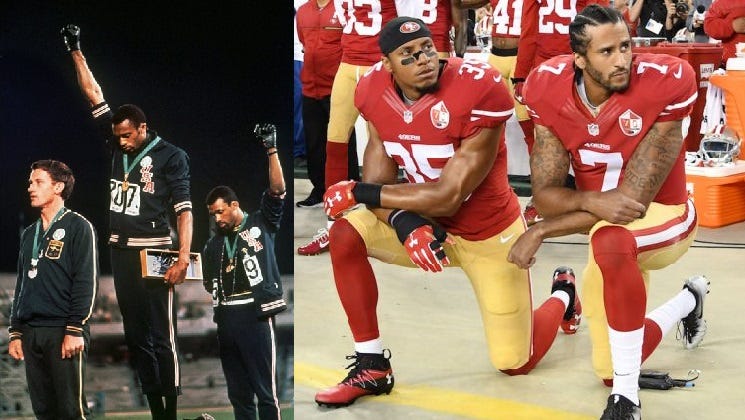

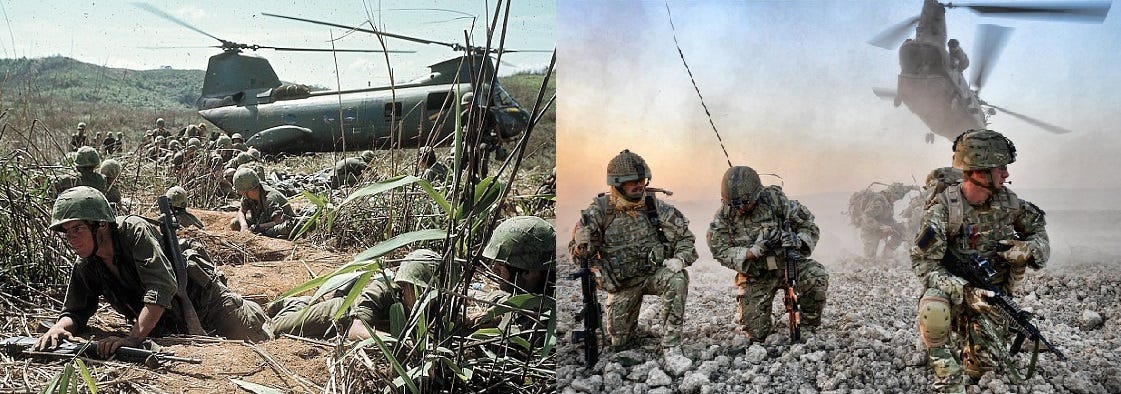


It’s telling that current Canadian Prime Minister Justin Trudeau’s father, Pierre Elliott Trudeau, was sworn into that same office in 1968. The corollaries between that year and this — a conservative political climate committed to the restoration of “law and order”, black athletes protesting entrenched racism, a long standing American military occupation of foreign soil, nationalist politicians speaking out against immigration — are numerous enough to give pause. There is one marked difference, however. When the powers seeking to maintain the cultural and economic establishment they aimed to dismantle came out to crush them, rather than sit around and complain about the status quo, the boomers actually took to the streets and did something about it.

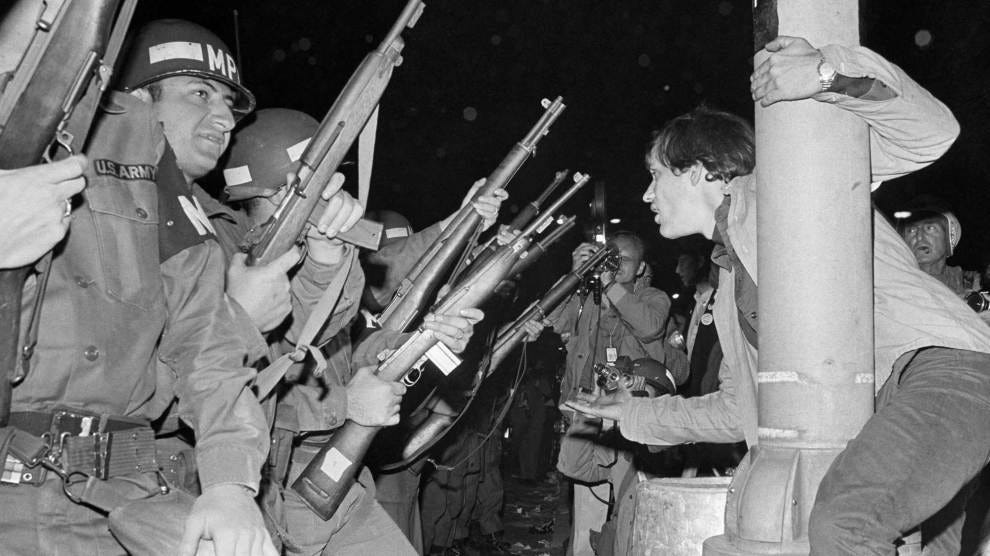
And they had every reason not to. One by one, the leaders of their movement, beginning with JFK in 1963, had been assassinated, often right before their eyes. Their government, society at large, even their parents, were all aligned against them. They were literally attacked, jailed, beaten, shot. And still they struggled on.

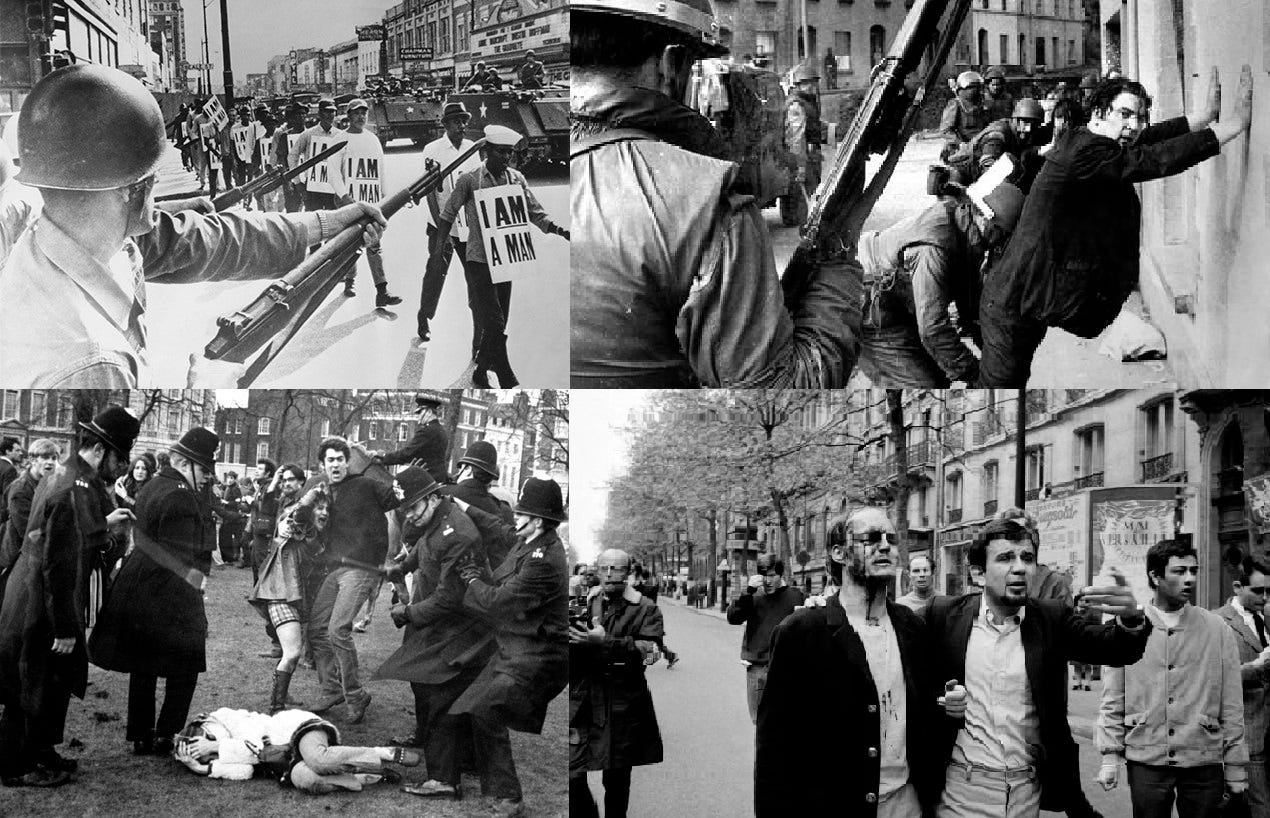
Compare that to today, when, faced with levels of inequality and injustice that rival the days of serfs and emperors, the best we can muster is a hashtag campaign on social media. It’s sad really. Every attempt at moving forward, at creating the level of fundamental shift such as the boomers achieved in 1968, is consumed from within, sold out before it can even begin to assume its true potential. Sure, Steve Jobs and Bill Gates went corporate, but only as a means for achieving their greater goal, that of enabling others. The money just followed. Gen X spent no time at all devolving the internet into a commodified caricature of its original intent. Those attending the current analogue, cryptocurrency and blockchain, with their arguably greater capacity for moving humanity into the next epoch of prosperity and enlightenment, didn’t even wait that long.
Could it be that we are incapable of such conviction? That this is one of those things, like so many others, that the boomers neglected to impart to us? Can we hope to regain the fortitude necessary to persist in the face of seemingly insurmountable social, economic and cultural forces, to endure suffering, almost certain failure, maybe death? Is it possible that, as they did in ’68, we need the boomers to take it to the streets, that we might actually need Joe Biden to show us the way?
The problem is, I don’t think they have it in them. And it’s not just my personal “hang-up” with the boomers, to borrow a term they popularized, that leads me to say this. They have told me so themselves.
“We really need the college students of today, and the Gen Xers of today, to take over the world, sooner rather than later,” climate scientist Dr. Steven Running informed me during a recent podcast interview. “Because I have to admit, my generation doesn’t have enough guts to make the changes, they’re too wed to the fossil fuel life, and I think we’re more of the problem then we’ll ever be the solution.”


Still, I wonder if we have the courage, or the skill set. Because, on this golden anniversary of the Year of Protests, the very same war rages on, and we’re not in the streets, and least not like the boomers were. We’re still wed to the same systems — political, social, economic — the majority of which are completely incongruous with our new global civilization, to say nothing of the ecosphere, and I see no indication that we’ll change. It’s clear that, as demonstrated by the successful memes of Brexit and MAGA, all we really want is for things to return to some romanticized vision of the past.
So now we’re putting it on the next generation to save us. But the trouble is, even if the college students of today were to heed Dr. Running’s exhortation, we’re asking them to do so while bound by a straitjacket. We make up the system, the framework, the infrastructure in which the millennials and their younger counterparts are forced to operate. Their generating the impulse necessary to change its momentum would be challenge enough even with our cooperation, let alone when half the available energy is either at rest or actively opposing it.
In other words, this is hard fucking work. No disrespect to Dr. Running, who is still in the trenches, but we’re going to need all hands on deck. Because, unlike the boomers, we’re not merely upending a prevailing culture. What we’re dealing with isn’t just a change in mindset, although that is still an important part of the equation. We literally have the entire apparatus supporting our existence to remake.
Prior to 1968, it was okay to treat people like second-class citizens. It was okay to exploit developing countries through imperialist policies and military action. Those practices were de rigueur. Post 1968, it’s no longer okay, but we continue doing so because our system requires it. And that system is what we have to change.
For all my personal animosity toward the boomers, I readily admit we’re indebted to them, and not just because they gave me life. They spawned an entirely new breed of idealism, one that advanced the notion of equality beyond de facto to make it a priori and then extended it to the rest of the living and non-living systems as well. They altered our very expectation of how the world should be. Quite unlike the virtual nihilism we practice today, the boomers actually believed they could make a difference, and, in 1968, did everything in their power to see that occur.
But this is 2018, not 1968, and it’s high time we manifest that expectation in reality and make incarnate the ideals that the boomers fought to enshrine. Arguments that these things take time or that we must work within the constraints of the current system are worse than denial or outright refusal, only serving to highlight the fact that, while we recognize the need for action, we intend to do nothing about it. Largely because doing something quite likely means enduring the personal discomfort, hardship, and pain that we are currently externalizing to someone else.

Our predicament only becomes all the more vexatious with the realization that there is no one to turn our anger on, no establishment to rail against, no others. In 1968, the battle lines were clear — a new and progressive counterculture united against the forces of an old guard overtly and conspicuously intent upon ensuring the continuation of its ways. Today, we are the establishment, begrudgingly upholding the status quo through a mix of fatalism, apathy, and the understanding that the only confrontation we can expect to have is with ourselves.
That is not to say there is not an established order, a prevailing modality that shouldn’t be assailed and dismantled with the same ardent fervor and resolve as the boomers afforded segregation. There is. It just isn’t going to present itself in the form of us against them. This time around, it is us against ourselves.
Still, we shouldn’t fear the fight, if only to prove to the boomers that we are as capable of driving change in 2018 as they were in 1968. That the generation who tore down the Berlin Wall isn’t about to let another go up. That our policy of non-participation really was a calculated strategy, not a mere attempt at avoidance.
So what does the fight of 2018 look like in real terms? At its core, it revolves around our putting outcome and purpose back in the driver seat and relegating the pursuit of profit to an impetus, rather than an end unto itself. More concretely, it’s about devising solutions to fundamental problems rather than those created by our failure to do so or our desire for distraction. And it means coming to terms with the fact that we really are one unified global community, no matter if we want to be or not.
There is absolutely no chance that we are not moving beyond this present state. It is inevitable and, at the current rate of change, will happen sooner than we think. The only matter up for debate is whether we want that future to resemble a scene from Star Trek: The Next Generation or one from Soylent Green. It’s a catechism we cannot avoid, and, it fact, the question has already been posed. About that, there is nothing we can do. Determining the answer, however, is entirely up to us.
Wednesday, July 27, 2011
Always Something
Water continues to be the theme in Western Montana, which is good, because it is the most important thing. The grass is tall in the fields and the weeds high in the ditch. Some of the sow thistle between Silver Sage and here is over seven feet. I would have thought the mosquitoes would be worse, but so far they have hardly appeared at all.
The fire season has been nonexistent, which should translate into more free time, but it hasn’t. Most of the projects I had thought to accomplish haven’t even been started, let alone finished. We should get the rest of the dog yard fenced this Friday and that will be nice. The irrigation is flowing and just keeping up with the lawn using a borrowed reel mower is about all we can manage.
We had Melissa from the Ravalli County Weed District come by and identify all our succession vegetation for us. Mostly we got mustard. She did point out some Canada thistle, which we knew about, but she also noted that we had some field bindweed growing amongst the landscaping on the south side of the house. Everyone, even brother Jeb, makes an ugly face when I mention the field bindweed, so I tend to believe it will be hard to get rid of. Fortunately we haven’t seen it in the pasture yet, and I can only hope we don’t. The grass is relatively well established in there and healthy, always the best defense against invasion.
Melissa recommended we use Roundup on the mustard patch around the stable, on the two potentially harmful gigantor nightshade plants we discovered, and on the area where we found the field bindweed. I don’t much like the idea of using that stuff but I don’t know much about it. I asked around a bit and word on the street is that it is has no adverse effects on humans, nonetheless I’m rather hesitant. After a little Wikipedia indoctrination, I’m even more so.
I don’t see mustard as much of a threat, and the nightshade we may be able to beat back with a pair of trimmers. Our neighbor Rod down the road has offered to help us to spot spray the Canada thistle with some Milestone. Brandi dug up most of the sow thistle and a couple more seasons of that should take care of it. She also has been cutting seed heads off the Canada and I’ve been pulling the bindweed before it flowers in some attempt at control.
Getting out of the weeds a bit, the big news in our world is that Brandi has accepted a permanent position at Rocky Mountain Laboratory. That means we’ll be sticking around the Bitterroot for awhile, and I like the feel of it. It gives us the confidence to really invest ourselves in the smallholding and the community for the long term and allows us freedom to consider a greater range of possibilities. Now I can imagine working this place over the course of ten or twenty years. It’s exciting.
In the mean time I’ll just try to keep up with Keegan and the lawn mowing, which may have just got easier since the irrigation has quit again. Guess I shouldn’t have opened those valves in the pasture.
Thursday, February 10, 2011
Ah, Peace & Quiet
It’s pretty quiet around our place. Not literally, of course, but in the sense that not much has happened as of late. In literal terms, it’s anything but quiet. Howling huskies, squalling pups, clucking hens, and a babbling baby all conspire to ensure that silence only occurs for short periods in the dead of night.
It’s winter, so our world revolves primarily around … dogs! A return to more seasonal weather had us headed up the West Fork again, where we found the recent cold snap and snowfall had vastly improved trail conditions. The dogs all ran well and little Icy got her first taste of the trace. Paluk’s pups are four weeks old and as cute as ever. I get endless enjoyment from asking Brandi which one of them she is going to keep.
“So, we can keep a puppy?”
“No. It’s just a thought experiment.”
“Oh.”
The chickens we got from our smokejumper bro Rogers haven’t been producing any eggs. They got a little traumatized by the inevitable dog v. chicken encounter which occurred the very first day we had them on the property, but they still offered up an egg a day for a week or so. Now they aren’t producing at all. I’ve asked around a bit and it seems they aren’t unique in this. My buddy Sells’ urban flock in Missoula isn’t producing either. He is running heat lamps and we aren’t, so that doesn’t seem to be a significant factor. I should do some more research online, but I will probably just wait until spring when the days get longer and things warm up and see what happens then.
Despite my best efforts, I have more or less come to grips with the fact that the dogs are going to take up a lot more space than I had originally imagined and that their presence is going to seriously hinder our ability to host other livestock. I’m really none too stoked to come walking out the back door to find four of them hanging from the neck of a shrieking sheep, so abstinence is the best policy there. I still maintain hope for a couple of weaner pigs and a cow, but I've finally accepted that flora may be more the focus than fauna in the near term.
I’ve been doing some reading about food forests and garden design and I’m pretty excited about planting some fruit trees and berry bushes this coming spring or fall. I’m thinking about taking a pretty loose approach to gardening this year and basically just throwing seeds wherever there is some bare dirt. I would really like to put some bulbs and native shrubs in as well, and I’m really interested in starting some hops on the fence around the dog yard. But as with everything, how much I can accomplish will largely depend on the availability of those two scarcities, time and money.
I’ve been doing some reading about food forests and garden design and I’m pretty excited about planting some fruit trees and berry bushes this coming spring or fall. I’m thinking about taking a pretty loose approach to gardening this year and basically just throwing seeds wherever there is some bare dirt. I would really like to put some bulbs and native shrubs in as well, and I’m really interested in starting some hops on the fence around the dog yard. But as with everything, how much I can accomplish will largely depend on the availability of those two scarcities, time and money.
Keegan turned one last month and has become upwardly mobile. His favorite thing in the world is taking hold of a pair of fingers and marching back to the bathroom to fetch his toothbrush. He can crawl, pull himself up on the furniture, and stand no-handed for a half second, but he has a terrible habit of not going all the way to the ball and is always pulling up short and having to reach in. We’ve been working on fixing that.
A glorious thing about one year old Keegan is that he speaks. Not English, but a language that is entirely his own. He often sits there and rattles on to himself for minutes on end. You can’t understand a word of it, but he knows what he's saying. I don’t know where he got it but he’s quite the orator. He loves to spout off some longwinded tale and then finish with Keegan’s patented “I Approve” salute, which is always worthy of a laugh.
So that’s what I mean when I say it has been pretty quiet. No sonic booms or explosions. Just a dull roar.
Wednesday, January 26, 2011
Do They Not Teach Physics in School Anymore?
There is something that has been bothering me, and it isn’t the eight puppies that we need to find homes for, the hitch that I’ve noticed in Isis’ gait, the lack of snow in the Bitterroot, or the fact that JFK, Bobby, MLK, and Malcolm X were assassinated, all in a relatively short time span and all by men with rather dubious motives, simply for trying to, as Spike Lee put it, do the right thing.
In truth, all those things are bothering me, especially the concerns I have about the dogs, in whom I have a vetted interest and over which I have at least some influence, but this is something else. It’s a simple thing, one that has been a recurrent theme of late, an underlying thread linking a multitude of topics. I found it in a book on permaculture I’ve been reading, and it bubbles to mind whenever I endure another news story about our faltering economy. It has to do with attitude, and, when it comes to human endeavor, attitude is everything.
The instance in the book was a passage about capturing rainwater. The author’s message: Utilize it. Otherwise, it simply goes to waste.
Now wait a minute. If I don’t intercept it, it goes where? Well, someplace. And it does what when it gets there? Well, something.
Likewise, the economy. According to most, it has gone on hiatus. Retreated, like a turtle into its shell. Consumers, the primary drivers of the economy, are no longer spending. So they must be saving, right? Actually, no. Lending? Nope. Investing? No, that isn’t happening either.
Has everyone forgotten that, sunlight and the occasional meteor/spaceflight aside, we live in a closed system? No matter whether we are talking hydrology or economics, the first law of thermodynamics still applies. Money and water can neither be created nor destroyed. They can only be moved around the planet.
Granted, that isn’t exactly true, especially about the money, but for the purpose of this argument it is. Those resources are somewhere, and they are doing something. The real crux of the matter is that, with both sides of the equation being equal, what we do in one place will have a profound influence on things in another. The question is whether it has a positive net effect (for humanity at least) or whether it sets off a cascade of events the consequence of which we cannot even begin to comprehend.
In the case of the economy, it’s pretty obvious. Take away the rainwater and the earth becomes a desert.
Or does it?
Or does it?
According to the International Monetary Fund, in 2009 the gross domestic product of America shrunk at a rate of minus 2.633%. China’s GDP, on the other hand, grew at a rate of 9.096%. That same year, the GDP of Afghanistan and Iraq increased by 22.545% and 4.5% respectively.
On second thought, maybe I should start collecting rainwater. Better than just letting it run off the roof, down the Bitterroot, and across the Pacific to do God knows what.
I wonder, if they could do it over again, whether the Kennedys would keep their mouths shut about Vietnam. And would anything be different if they did.
Subscribe to:
Posts (Atom)


 Posts
Posts


